

### Understanding Suffering and Relationships through Buddhism and EFT
Human suffering is a fact. Billions of people knew even before the coronavirus that they couldn't really be sure that they would have something to eat tomorrow and that their world would remain protected and stable. For most of the people who are in the comfortable place at the top of the privilege pyramid, the matter became clear only recently. Fortunately, many are also trying to address this problem. Buddhism, for example, is one of the oldest and most profound answers to human suffering, and psychotherapy is one of the relatively new answers.
Being an emotionally focused therapist interested in Buddhism, I am intrigued by the fact that the EFT approach is very different from Buddhism in the way it tries to alleviate human suffering. Of course, it is impossible to really compare the thousands of years of Buddhist thought and practice and the huge number of students of Buddhism with the world of psychotherapy as it is, but I am fascinated by the theoretical differences between the approaches.
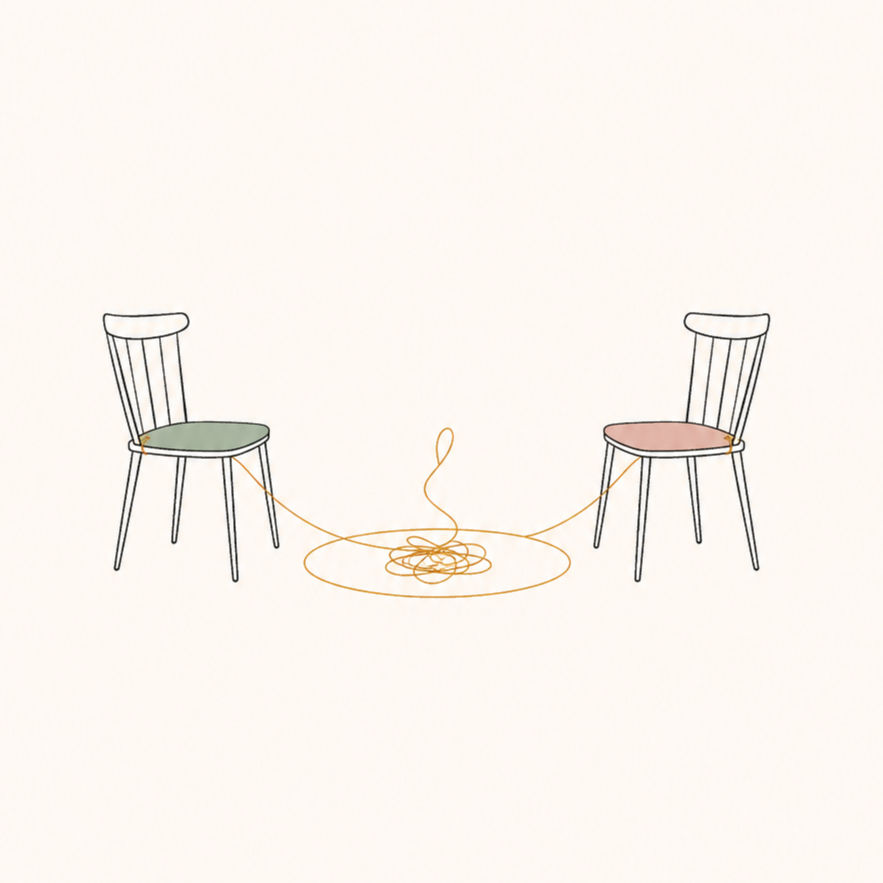
In my understanding, according to Buddhism, existential suffering stems from the mind's mistaken clinging to the idea of a real and permanent "I," and from our habitual attempt to cling to other transient phenomena. These phenomena can be life situations such as age and marital status, material objects such as money and possessions, or psychological objects such as thoughts and feelings.
In contrast, emotion-focused individual therapy explains human suffering as stemming from a stuck emotional processing system, leading us to react abnormally to triggers in our environment. For example, in situations where we should feel sadness, we instead feel anger or emotionally disconnect.
Emotion-focused couple therapy explains human suffering, or at least part of it, as a response to a situation where our primary attachment needs are not met within a relationship. According to this approach, if we are better emotionally "screwed" to our life partners, we can better deal with life's challenges, significantly reducing our suffering.
On the surface, there is a significant contradiction here. Despite this, I am drawn to the attempt to establish a partial dictionary between the languages so that the world of couple therapy can benefit from Buddhist wisdom. The first concept I want to translate from the Buddhist language into the language of EFT is karma, which in the language of couples therapy means "Loop." Because what is the negative (or positive) loop if not a specific, tangible, and common example of the law of karma?
Tibetan Buddhism explains that karma is created by any actions - physical actions, speech, or thought - and that each of our actions creates an inconceivable chain of reactions. Karma, in this sense, is a universal law and not an ethical rule in the religious or moral sense. It simply is, regardless of concepts like justice, reward, or punishment.
Similarly, according to the principles of emotion-focused therapy, every human action creates a chain of reactions on others. Two people in a continuous relationship, where they act against each other physically, in speech, or in thought, create a loop between them. In this case, it is not a judicial statement but a description of a situation. It's not "okay" or "wrong," that's just how it is.
To understand this, consider an example: if I arrive at work tired, I can do various things that will immediately affect my partner. My actions can be physical, such as yawning repeatedly, performing tasks slowly, or pecking while talking. They can also be speech acts ("I'm so tired, I don't know what's wrong with me") or mental actions, such as thinking to myself, "I'm ruined by fatigue, and how can she not see it, and how can you compare what I'm dealing with in life with what she's going through," or hoping she will take tasks from me that exhaust me.
One result of my actions when I arrive at work exhausted can be that my partner discovers her highest abilities because she empathizes with me or has to compensate for my weakness. Another possibility is that if I chronically arrive at work tired and under-functioning, my partner may respond with consistent over-functioning. The better she functions, the less needed and less successful I may feel, leading to a further decline in my functioning and a decrease in my sense of competence. And the less well I perform, the more she may be relegated to the position of "excellent," either out of defiance or necessity. At this point, my influence on my partner, and my partner's influence on me, becomes a loop.
Understanding the karmic cycle plays a fundamental role in both approaches. This understanding is a fundamental part of knowing the truth, which is the basis for the training and practice of consciousness in Buddhism. In the microcosm of couple therapy, the therapist's first step is to open the eyes of the couple seeking relief from their suffering.
Couples arrive feeling helpless, suffering greatly from the negative loop they are trapped in. Understanding the connection between their actions and this loop is crucial. The couples therapist uses their intellect to map the mutual influence they are trapped in and helps them break this pattern.
In this sense, emotion-focused therapy does not seek to correct the ways of the suffering person through judgmental means, similar to Buddhism. The marital therapist is not a kindergarten teacher who tells the couple how it is nice or not nice to behave according to moral or religious laws. Instead, the therapist helps them see the simple fact that has disappeared from their view - their contribution to the negative dynamics that characterize their relationship.