

Managing Self-Control During Challenging Times
Understanding Ego Depletion and Its Impact on Our Daily Lives
On Thursday, ten days ago, when I realized that my children would be without an educational framework for the foreseeable future, I wanted to cry but held back. I knew we were all in the same boat. I channeled my frustration into placing a large order on a major supermarket’s website, scheduled for delivery five days later on Tuesday. On Saturday morning, I remembered to add batteries and lice combs to the delivery, but updating my shopping basket postponed the delivery to Thursday. I wanted to break the computer but restrained myself.
On Saturday evening, like many others in Israel, I heard the confusing instruction, "He who does not have to - should not go to work." My nervousness escalated as family members asked whether I would continue meeting with patients or switch to online sessions. I didn’t know where to direct my stress, so I helped myself with two (well, generous) glasses of cognac, which did the job, and I didn’t fall apart. Later that night, my teenage daughter asked to go to a café with friends for the second time that day. We settled on take-away, and I managed to stay calm.
Photo Caption: An abandoned playground on the beach in Tel Aviv, March 2020. Instead of being disappointed in yourself, let go of non-essential challenges for the time being. Photo: Maged Gozni.
But then Sunday morning came. Despite not sleeping much the night before, I jumped out of bed at 6:30 AM when my seven-year-old son tapped my shoulder to tell me he was awake. To ease his boredom and restless temperament, we went to the neighborhood soccer field during early hours, usually reserved for oddballs. Our dog, Indy, an eight-and-a-half-year-old Jack Russell terrier, joined us.
A few minutes before 7:00 AM, we were in the deserted lot. Only the empty vodka bottles around the trash cans kept us company. I let the dog off the leash, hoping she’d chase a pigeon, but she just sat and watched us. My son and I played soccer with dedication, aiming to pass the ball without stopping. Our record was 52 passes, but that morning we reached 100 when, out of nowhere, a tall man dressed in black approached us. He petted Indy and asked, "Whose dog is this?"
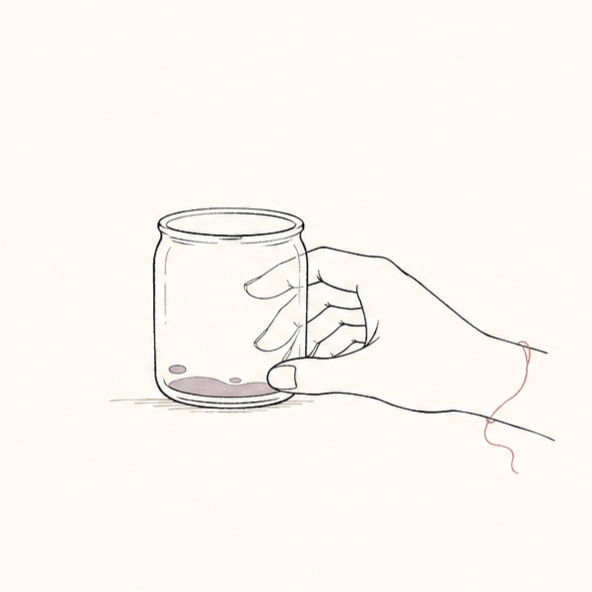
Photo Caption: The voice in the head: what the internal struggle with ourselves looks like.
At 7:15 AM, a city inspector caught me red-handed and, despite my pleas, fined me NIS 475. Nothing helped - the coronavirus, the school closures, the lack of previous convictions, the economic crisis, and promises of good behavior. I cried. The inspector told me I could go back to playing with my son, but I wasn't in the mood. He explained that I could appeal the fine and then quickly left. I tried to swallow my tears and not fall apart next to my child. After a few breaths, I managed to go back to playing.
Using intellectualization, one of my most useful defenses, I reminded myself of the real reason for my tears and its relevance to others at this time. I wasn’t crying because of the NIS 475 fine, the inspector’s rigidity, or the municipality’s harshness. I cried because self-control is a depleting resource.
Our self-control, possibly established early in life (and maybe partly innate), acts like a pool that empties when life demands a lot from us. While it does replenish, during challenging times, we can’t control ourselves as well as usual.
The American psychologist Roy Baumeister, known for his research on this phenomenon called Ego Depletion, conducted numerous experiments demonstrating that when we do one unpleasant thing, it becomes harder to control ourselves in other challenging situations. For example, people watching a boring movie become less able to exert themselves in a subsequent physical stress test, and those facing a frustrating cognitive challenge later show less self-restraint and eat more cookies.
While recent attempts to reproduce Baumeister’s findings have been less successful, the concept of "ego impoverishment" remains a useful metaphor for understanding our human experience.
On a regular basis, most of us use our willpower to face challenges like maintaining our figure, budget, and good relations with difficult colleagues or family members. Even in routine times, our self-control reserves are often depleted. The introduction of the coronavirus threat exacerbates this depletion.
These days, we must direct large parts of our self-control reserve to manage health anxieties, financial fears, logistical changes, and emotional pressures. How are we supposed to find more willpower to stick to budgets, diets, or maintain relationships?
This depletion explains why, after using all my self-control to deal with the pandemic, I didn’t have enough left to handle the inspector. That's why I cried, and it might be why you’ve gone back to smoking, drinking more, eating more carbs, spending more money, or fighting with neighbors. The solution is to acknowledge this depletion, reassess priorities, and let go of non-essential challenges.
After reflecting on this, I normalized my tears and calmed down. I returned to playing with my son, scoring from the three-point line—a memory of my short stint with Hapoel Tel Aviv’s girls’ team. "Mom," my son said admiringly, his sweaty hand in mine, "you are the best basketball player I've ever seen." And with that, my power bank was refilled.